
Sometimes, what feels like “stress,” “low mood” or unexplained tiredness may also have a physical component worth investigating.
You may feel exhausted despite getting enough sleep. Your concentration may not be what it used to be. You may feel unusually irritable, low, weak or mentally foggy. Perhaps you are experiencing headaches, dizziness, tingling, muscle weakness, changes in appetite or poor sleep.
Sometimes, these symptoms are related to stress, anxiety, depression, poor sleep or other psychological factors.
But sometimes, the body may be missing something it needs to function properly.
- Iron.
- Vitamin B12.
- Folate.
- Vitamin D.
- Other essential nutrients.
This doesn’t mean that every emotional or physical symptom is caused by a nutritional deficiency. But it is one of the reasons that a good mind–body assessment sometimes needs to look beyond psychological symptoms alone.
Your brain needs nutrients too
We often think about nutrition in terms of muscles, bones, blood and immunity. But the brain is one of the body’s most metabolically active organs. It needs a continuous supply of oxygen, glucose, amino acids, fatty acids, vitamins and minerals to maintain neuronal function.
Nutrients participate in processes such as:
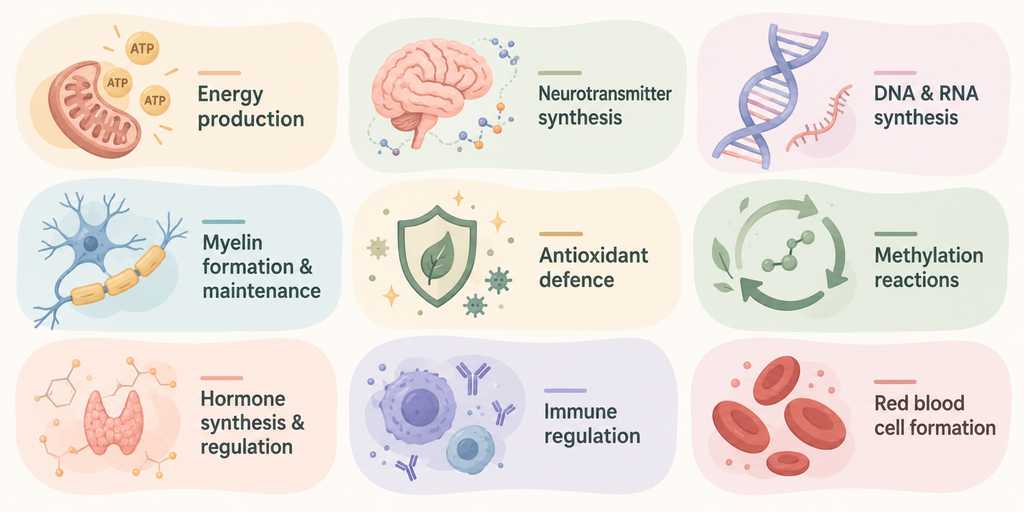
So nutritional status can influence both physical and neurological functioning. However, this does not mean that taking more vitamins automatically improves mental health. The important distinction is between correcting a genuine deficiency and taking supplements without an established need.
Iron: when low stores affect more than haemoglobin
Iron is best known for its role in haemoglobin—the protein that carries oxygen in red blood cells. When iron deficiency becomes significant enough to cause anaemia, people may experience:
- Tiredness
- Weakness
- Dizziness
- Headaches
- Shortness of breath
- Reduced physical capacity
WHO notes that iron deficiency is the most common nutritional cause of anaemia, although anaemia can have many other causes, including chronic disease, inflammation, blood loss and inherited conditions. World Health Organization
But iron also has important functions inside the brain.
Iron is involved in cellular energy production and several enzymes involved in neurotransmitter metabolism and myelin formation. Consequently, iron deficiency can affect neurological function even beyond its effect on haemoglobin. This is particularly relevant when someone presents with persistent fatigue, reduced concentration or reduced physical capacity.
But there is an important distinction:
Feeling tired does not automatically mean you are iron deficient.
The underlying cause needs to be established.
Vitamin B12: one deficiency with neurological and psychiatric consequences
Vitamin B12 is particularly interesting from a mind–body perspective. It is essential for normal DNA synthesis, red blood cell formation and neurological function.
Deficiency can produce neurological symptoms such as:
- Numbness or tingling
- Weakness
- Problems with balance
- Cognitive difficulties
It can also be associated with psychiatric or behavioural symptoms including depression, anxiety, agitation, impaired concentration, psychosis and delirium. PubMed
Importantly, B12 deficiency does not always present with anaemia or enlarged red blood cells. NICE specifically advises clinicians not to rule out B12 deficiency solely because anaemia or macrocytosis is absent. Nice
This is one reason B12 deficiency can occasionally be overlooked and the cause matters. It may relate to inadequate dietary intake, but it can also result from malabsorption, gastrointestinal disease or surgery, autoimmune gastritis, and certain medications, among other causes. Nice So simply taking a B12 tablet without understanding why the level is low may not address the whole problem.
Folate: closely connected to the nervous system
Folate, or vitamin B9, is involved in DNA synthesis and one-carbon metabolism, a group of biochemical reactions important for cellular function. Folate and B12 metabolism are closely interconnected.
Deficiency can contribute to megaloblastic anaemia and, in some circumstances, neurological and psychological symptoms.
Research has also explored folate supplementation as an adjunct to treatment for depression. However, the evidence is not strong enough to suggest that everyone with depression should routinely take folate. An earlier systematic review found limited evidence for benefit, particularly when used alongside conventional treatment, while noting uncertainty about its role in people with normal folate levels or true folate deficiency. PubMed
The important message is therefore:
Correct deficiency when it exists; don’t assume supplementation is a treatment for depression itself.
Vitamin D: more than a “bone vitamin”
Vitamin D is often discussed in relation to calcium and bone health. But vitamin D receptors are also found in various tissues, including the brain, and vitamin D has roles in neurobiological and immune processes.
Several observational studies have found an association between lower vitamin D levels and depression. A systematic review and meta-analysis involving more than 31,000 participants found lower vitamin D concentrations among people with depression, although the authors emphasised that association does not establish causation. PubMed
More recent research has continued to investigate whether supplementation improves depressive symptoms. Meta-analyses of randomized trials have produced mixed and heterogeneous findings, with some showing benefit and others highlighting low certainty or methodological limitations. PubMed
So the scientifically responsible conclusion is not:
“Vitamin D deficiency causes depression.”
It is:
“Low vitamin D and depression can be associated, and genuine deficiency should be recognised and treated but vitamin D supplementation should not be presented as a substitute for evidence-based depression treatment.”
That distinction matters.
The brain doesn’t work on one nutrient at a time
Another important point is that nutrients don’t function as isolated switches. The brain depends on networks of biochemical reactions.
For example:
B12 ↔ folate ↔ homocysteine ↔ one-carbon metabolism
Iron participates in enzymes involved in neurotransmitter metabolism and cellular energy.
Vitamin D interacts with neuroendocrine and immune pathways.
Other nutrients, including thiamine, vitamin B6, magnesium, zinc, iodine and essential fatty acids also have important physiological roles.
But this does not mean that taking a large collection of supplements will automatically improve mental health.
The body needs the right nutrients in appropriate amounts not necessarily more of everything.
Why can deficiency feel like a mental-health problem?
Imagine someone who has developed significant iron deficiency.
- They may feel exhausted.
- Because they are exhausted, they stop exercising.
- Because they have less energy, everyday tasks feel harder.
- They become less socially active.
- Their concentration decreases.
- They may become frustrated with themselves.
- Their sleep may deteriorate.
- They may begin to feel low or overwhelmed.
Now imagine someone with B12 deficiency experiencing cognitive changes, tingling or weakness. They may become worried about what is happening to their health.
But deficiencies are not the explanation for everything
The internet has made nutritional deficiencies extremely popular explanations for almost every symptom:
- Brain fog? – B12.
- Anxiety? – Vitamin D.
- Hair loss? – Iron.
- Depression? – Magnesium.
Real medicine is more complicated. The same symptom can have many possible causes.
- Fatigue can occur with anaemia, thyroid disease, sleep disorders, depression, anxiety, chronic illness, medications and many other conditions.
- Poor concentration can occur with sleep deprivation, anxiety, depression, ADHD, nutritional deficiencies and physical illness.
- Hair loss can have nutritional, hormonal, autoimmune, genetic and other causes.
Therefore, a symptom alone cannot tell you which deficiency; if any, is present.
And sometimes the problem isn’t intake it is absorption
This is particularly important. Someone can eat a reasonably nutritious diet and still become deficient.
Why? Because nutritional status depends on more than what enters the mouth.
It also depends on:
Intake → digestion → absorption → transport → metabolism → utilisation → losses
Conditions affecting the gastrointestinal tract can interfere with absorption of specific nutrients. Certain surgeries can do the same. Some medications can affect nutrient absorption or metabolism. Chronic inflammation and blood loss can also contribute to deficiency or anaemia.
For example, NICE identifies gastrointestinal conditions and previous gastrointestinal surgery among risk factors for B12 deficiency. Nice
So should everyone with mental-health symptoms get a vitamin panel?
Not necessarily.
Testing should be guided by the person’s symptoms, history, diet, medical conditions, medications, physical examination and risk factors.
For example, B12 testing becomes particularly relevant when compatible symptoms occur alongside risk factors, and NICE recommends clinical judgement rather than indiscriminate testing of everyone. Nice
A clinician may consider investigations when there are features suggesting:
- Nutritional deficiency
- Anaemia
- Malabsorption
- Gastrointestinal disease
- Restricted dietary intake
- Neurological symptoms
- Unexplained fatigue
- Relevant medication exposure
- Other physical conditions that could mimic or worsen psychiatric symptoms
The exact investigations should be individualised.
What about supplements?
This is where “more” is not always better. Taking unnecessary high doses of supplements can sometimes cause harm, interact with medicines or interfere with the interpretation of laboratory tests. And supplementation should not become a substitute for investigating why a deficiency occurred in the first place.
If someone is genuinely deficient, the important questions are:

How should response be monitored?
For B12 deficiency, for example, NICE recommends considering the underlying cause and tailoring replacement according to whether the problem is dietary, medication-related, malabsorptive or due to an irreversible condition. Nice
A better way to think about deficiencies
Instead of thinking: “Which vitamin is causing my symptoms?”
Try thinking: “Could there be a physical factor contributing to what I am experiencing?”
That small change in thinking is important. It prevents us from reducing every symptom to a deficiency while also preventing us from overlooking genuine physical contributors.
The Mind × Body perspective
Mental health exists within a body.
The brain needs oxygen, glucose, nutrients and energy.
The body responds to stress.
The gut communicates with the brain.
Hormones influence mood and cognition.
Sleep affects emotional regulation.
Physical illness can affect psychological wellbeing.
And psychological distress can influence how we experience and respond to physical symptoms.
This is not an argument for replacing psychiatric care with supplements.
It is an argument for looking at the person more completely.
The takeaway
Nutritional deficiencies can sometimes contribute to fatigue, cognitive difficulties, neurological symptoms, mood changes and other physical or psychological experiences.
But a deficiency is only one possible piece of the puzzle. Good Mind × Body care asks:
- What are the symptoms?
- What could be causing them?
- Is there a nutritional or medical contributor?
- Could psychological factors also be involved?
- Are several factors interacting at the same time?
Because sometimes the answer isn’t mind or body.
It is mind × body.
At MANOGAT
At MANOGAT, we believe that understanding mental health sometimes requires looking beyond the mind alone.
A person’s nutrition, physical health, sleep, hormones, gastrointestinal health, psychological experiences and social circumstances may all contribute to how they feel and function.
That doesn’t mean every symptom has a hidden deficiency.
It means that important possibilities should neither be assumed nor overlooked.
Mind × Body – because the whole person matters.
This article is for general educational purposes and does not replace individual medical assessment, laboratory testing or treatment. Nutritional supplements should not be started in high doses without appropriate medical advice.
References & Further Reading
- World Health Organization. Anaemia. WHO, 2025. Covers causes of anaemia, including iron, folate and B12 deficiency, chronic disease, inflammation, blood loss and impaired absorption. World Health Organization
- National Institute for Health and Care Excellence (NICE). Vitamin B12 deficiency in over 16s: diagnosis and management (NG239). 2024. Guidance on symptoms, risk factors, diagnosis, causes and treatment of B12 deficiency. Nice
- Anamaria Han et al. Exploring neuropsychiatric manifestations of vitamin B complex deficiencies. Frontiers in Psychiatry. 2025. Reviews neurological and psychiatric manifestations associated with B-vitamin deficiencies. PubMed
- Chaturvedi SK, et al. Neuropsychiatric manifestations in vitamin B12 deficiency. 2022. Reviews depression, anxiety, psychosis, cognitive symptoms and other neuropsychiatric manifestations associated with B12 deficiency. PubMed
- Anglin RES, et al. Vitamin D deficiency and depression in adults: systematic review and meta-analysis. British Journal of Psychiatry. 2013. Examines the association between vitamin D status and depression. PubMed
- Gowda U, et al. The effect of vitamin D supplementation on depressive symptoms in adults: a systematic review and meta-analysis of randomized controlled trials. 2022. Reviews randomized evidence and highlights the heterogeneity and uncertainty surrounding supplementation. PubMed
- Taylor MJ, et al. Folate for depressive disorders: systematic review and meta-analysis of randomized controlled trials. Journal of Psychopharmacology. 2004. Reviews the limited evidence for folate as an adjunct in depression treatment. PubMed