Understanding the person behind the diagnosis
When someone is diagnosed with anxiety, depression, insomnia or another health condition, it is natural to ask: “Which medicine is used for this condition?”
In Homoeopathy, treatment begins with a different question: “How does this condition present in this particular person?”
This is the basis of individualisation in Homoeopathic practice.
One diagnosis, different experiences
Two people may have the same diagnosis but experience it very differently. Their symptoms, emotional responses, physical complaints, triggers, coping patterns, sleep, relationships and life circumstances may all differ. Homoeopathy therefore traditionally aims to understand the individual case, rather than selecting a medicine solely from the diagnostic label.
This principle is described in Hahnemann’s Organon of Medicine. In Aphorism §3, the physician is expected to understand what is to be cured in the individual case and to adapt the medicinal treatment to that particular case. Organon of medicine
What does individualisation involve?
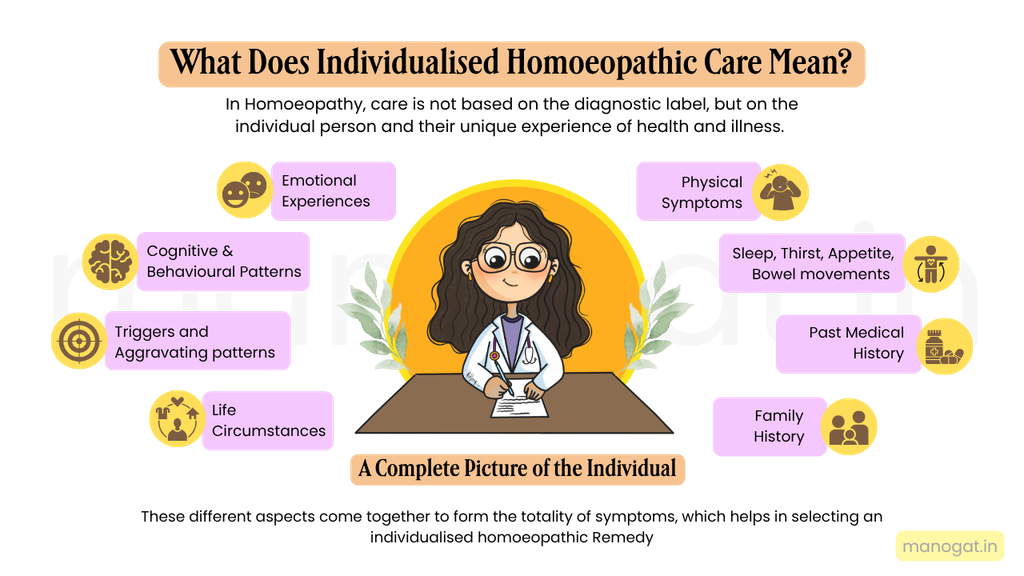
An individualised Homoeopathic consultation may explore:
- The main complaint and its development
- The nature and pattern of symptoms
- Factors that aggravate or relieve them
- Emotional and psychological experiences
- Sleep, appetite and energy
- Physical symptoms
- Relevant life events and circumstances
- Past medical and treatment history
- Characteristic features that distinguish one person’s presentation from another
Hahnemann’s Aphorism §5 specifically describes the importance of considering circumstances such as the exciting causes of illness, the person’s constitution, occupation, habits, age and social and domestic circumstances when taking the case. Classical Homeopathy Academy
In Aphorism §6, Hahnemann emphasises observing the patient’s condition and the symptoms that are actually present, rather than relying on assumptions about the underlying illness. Homeopathy Online
Why are characteristic symptoms important?
Not every symptom carries the same individualising value.
A headache, fatigue or disturbed sleep, for example, can occur in many different conditions and in many different people.
Aphorism §153 gives particular importance to the “striking, singular, uncommon and peculiar” or characteristic symptoms of the individual case. These distinguishing features are used in comparing the case with the known symptomatology of medicines. Organon of medicine
This is why two people with the same diagnosis may receive different Homoeopathic prescriptions.
Individualisation and the totality of symptoms
In classical Homoeopathic terminology, the totality of symptoms refers to the overall symptom picture of the individual case. The aim is to bring together the relevant features rather than selecting a remedy from a single symptom in isolation.
Aphorisms §147 and §153–154 describe the process of comparing the totality of the case with the known effects of medicines and selecting the medicine whose symptom picture most closely corresponds to the characteristic features of the case. Homeopathy Online
Contemporary Homoeopathic research has also described individualisation as the process of arriving at an “image of the patient” for remedy selection, with construction of the totality of symptoms being a commonly used approach. IJRH
What does this mean in mental health?
Mental-health conditions are particularly individual in their presentation. Two people with anxiety may both experience excessive worry, but one may primarily struggle with restlessness and insomnia, while another may experience prominent physical symptoms, fear, avoidance or difficulty coping with particular situations.
Similarly, people experiencing low mood may differ considerably in their emotional, cognitive, behavioural and physical experiences. Individualised Homoeopathic case-taking attempts to understand these differences as part of the person’s overall presentation.
Diagnosis and individualisation are not opposites.
A diagnosis can help identify and understand a clinical condition. Individualisation asks how that condition is experienced by this particular person. Both perspectives can contribute to a comprehensive understanding of the individual.
In simple terms
Diagnosis tells us what condition we may be dealing with. Individualisation asks: “What is distinctive about this person’s experience?”
In Homoeopathic practice, that individual symptom picture forms the basis for selecting an individualised remedy.
References & Further Reading
- Hahnemann S. Organon of Medicine. 6th ed. Aphorisms §§3, 5, 6, 147, 153–154.
- Kumar N, Iyer N. An observational study on the effect of individualised homoeopathic medicine administered based on totality of symptoms vis-à-vis personality in cases of osteoarthritis knee. Indian Journal of Research in Homoeopathy. 2021;15(2). IJRH
- Hahnemann S. Organon of Medicine, Aphorism §153 — characteristic symptoms and individualised remedy selection. Organon of medicine