
Understanding a specialised approach to mental health
When people hear the word psychiatry, they often think of mental illness, psychiatric medicines or a diagnosis.
But psychiatry is much broader. It is concerned with understanding mental, emotional and behavioural health including how our thoughts, emotions, physical health, relationships and life circumstances can influence the way we function.
So, where does Homoeopathic Psychiatry fit in?
A meeting point between Psychiatry and Homoeopathy
Homoeopathic Psychiatry is a postgraduate specialty that brings together knowledge of psychiatry with the principles and clinical practice of Homoeopathy.
In India, M.D. (Homoeopathy) – Psychiatry is a recognised postgraduate specialty under the National Commission for Homoeopathy. The postgraduate training includes both Psychiatry and Homoeopathic Psychiatry, along with research methodology and biostatistics. National Commission for Homoeopathy
This means that a Homoeopathic Psychiatrist is trained to understand mental-health conditions from a psychiatric perspective while also being trained in the principles and practice of Homoeopathic medicine.
But what does that actually mean in everyday practice?
More than putting a label on a problem
Imagine two people who both experience anxiety.
One may constantly worry about their family and future. Another may experience intense physical sensations, disturbed sleep and difficulty concentrating. Someone else may develop anxiety after a major life change.
The diagnosis may provide a common clinical framework, but the lived experience can be very different.
Homoeopathic Psychiatry brings the Homoeopathic principle of individualisation into this setting looking at the person’s characteristic mental, emotional and physical experiences rather than viewing the diagnostic label as the entire story.
The details of how this individualisation works are explored separately in What Does Individualised Homoeopathic Care Mean?
It is still Psychiatry
An important part of understanding Homoeopathic Psychiatry is recognising that it does not mean looking at mental health without psychiatric knowledge.
Postgraduate training in Homoeopathic Psychiatry includes areas such as psychiatric interviewing, mental-status examination, psychiatric diagnosis, assessment of severity and risk, contemporary diagnostic frameworks, investigations and recognition of mental-health crises. National Commission for Homoeopathy
This psychiatric foundation helps the practitioner understand what a person may be experiencing, how significant it is and what level of care may be appropriate.
The Homoeopathic component then brings its own clinical principles to the understanding and management of the individual.
More than treating mental illness
Mental healthcare is not only about treating an established psychiatric disorder.
It also includes promotion, prevention, early recognition, treatment, follow-up and rehabilitation.
The current NCH curriculum describes Homoeopathic Psychiatry as having a role across preventive, promotive, curative and rehabilitative aspects of mental healthcare. National Commission for Homoeopathy
This is important because people do not always seek help with a neatly defined diagnosis.
Sometimes they come because:
- They have been feeling overwhelmed for months
- Sleep has changed
- They are finding it difficult to cope
- Their mood has been persistently low
- Physical symptoms seem to accompany emotional distress
- A major life event has affected their wellbeing
- They are worried about a family member
Understanding these concerns early can be an important part of mental-health care.
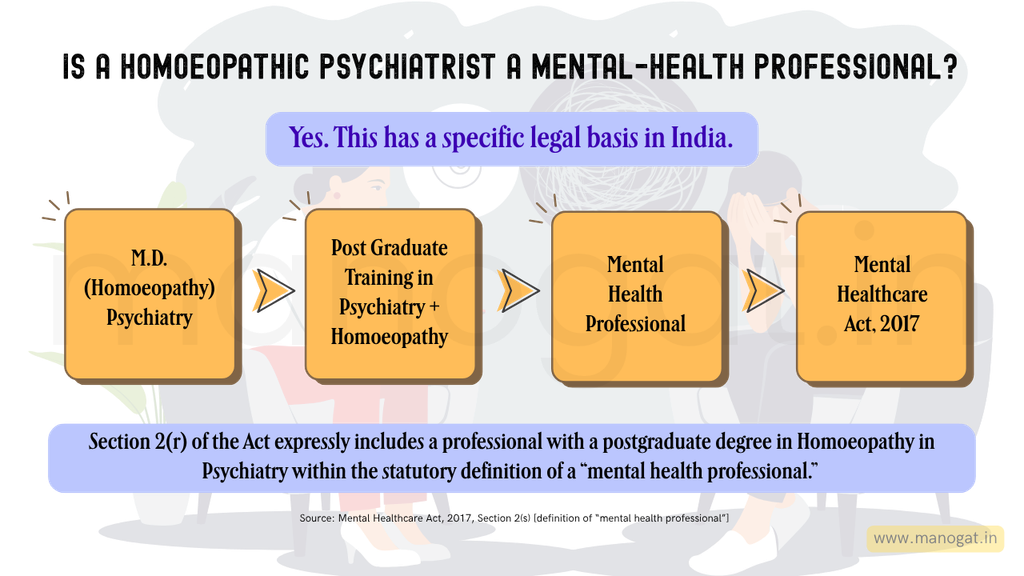
Is a Homoeopathic Psychiatrist a mental-health professional?
Yes. This has a specific legal basis in India.
The Mental Healthcare Act, 2017 expressly includes a professional holding a postgraduate degree in Homoeopathy in Psychiatry within its definition of a “mental health professional.”
The Act is designed to protect, promote and fulfil the rights of people receiving mental healthcare and services.
This recognition is important because it places postgraduate Homoeopathic Psychiatry within India’s broader legal framework for mental healthcare.
Mental healthcare is rarely one-dimensional
A person’s mental health can be influenced by many things, biology, physical health, psychological experiences, relationships, family, work and the wider social environment.
Consequently, mental healthcare may sometimes involve more than one professional or approach.
Depending on the situation, care may involve Homoeopathic care, psychological interventions, psychiatric treatment, medical evaluation, family support, lifestyle measures or referral to another specialist.
Recognising when additional care is needed is an important part of responsible mental-health practice.
So, what is Homoeopathic Psychiatry?
In simple terms:
Homoeopathic Psychiatry is a postgraduate specialty that combines formal psychiatric knowledge with the principles and clinical practice of Homoeopathy in the field of mental health.
It seeks to understand mental-health concerns while also recognising the individual behind the diagnosis.
And perhaps that is the simplest way to think about it:
Psychiatry helps us understand the condition.
Homoeopathic individualisation seeks to understand the person experiencing it.
Together, these perspectives form the foundation of Homoeopathic Psychiatry.
References & Further Reading
- National Commission for Homoeopathy. Competency Based Dynamic Curriculum for MD (Homoeopathy) – Psychiatry. Government of India. NCH — MD (Homoeopathy) Psychiatry Curriculum
- Mental Healthcare Act, 2017. Act No. 10 of 2017, Government of India. India Code — Mental Healthcare Act, 2017
- National Commission for Homoeopathy. Homoeopathy Post-Graduate Degree Course — Doctor of Medicine in Homoeopathy Regulations, 2024. NCH — Rules & Regulations
- National Commission for Homoeopathy Act, 2020. Government of India. India Code — National Commission for Homoeopathy Act, 2020